
How Post Assembly Works
A walkthrough of the full editorial workflow — from capturing an idea to publishing a post that sounds like you wrote it.
Step 1 — Extract
Get your thinking into the system, wherever it lives.
Drop in a podcast episode, a document, or a voice memo. Or capture an idea mid-conversation with your AI agent. Post Assembly handles transcription and ingestion automatically — you don't touch a transcript.
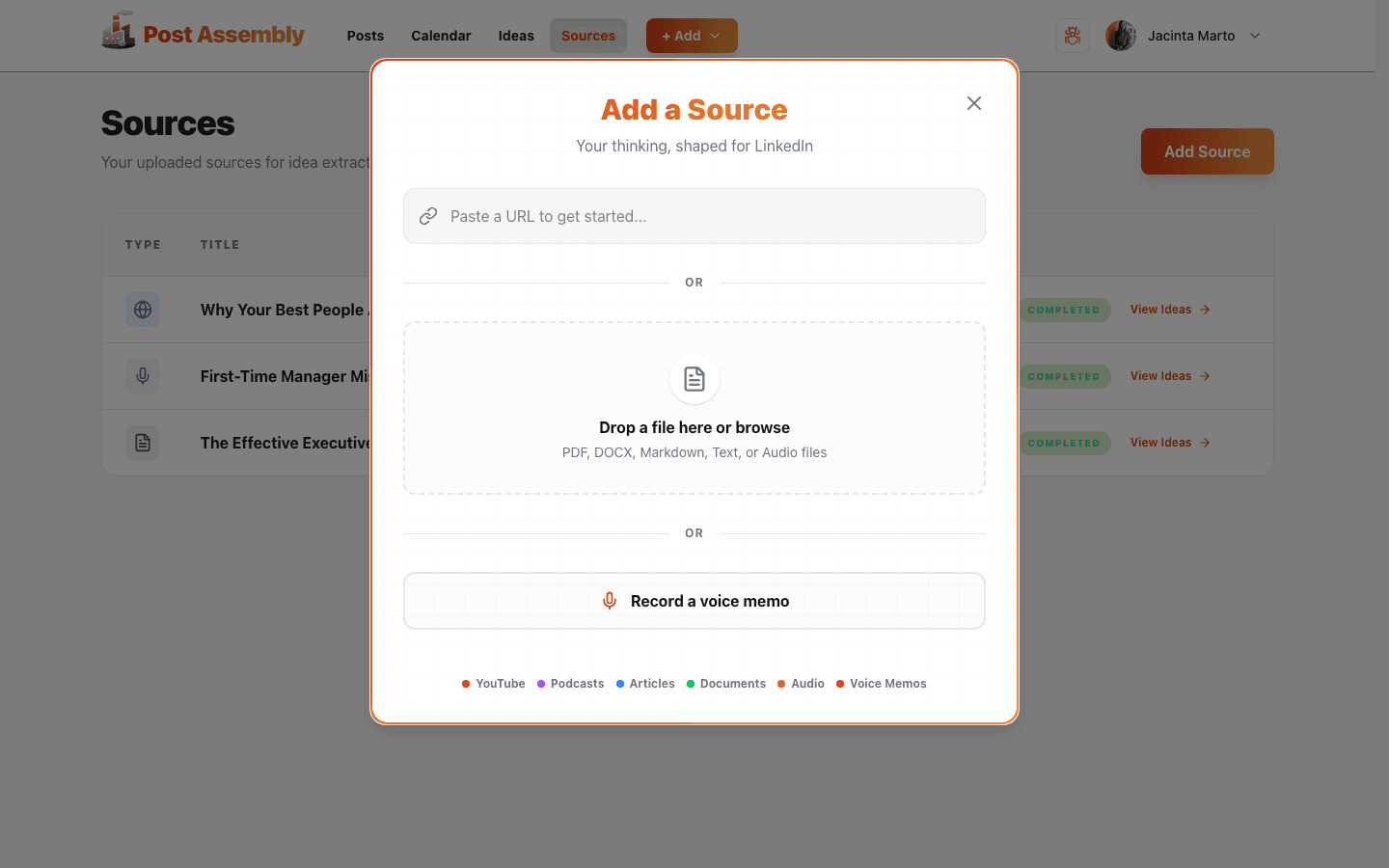
Done — I created ‘First-Time Manager Mistakes — HBR Podcast Notes’ and found 4 ideas worth developing. Want to review them?
Step 1 — Extract (continued)
The system finds the ideas inside
Most tools would give you a summary. Post Assembly reads your source material and identifies individual ideas worth developing — moments of conviction, frameworks, concrete examples, counterintuitive observations. Not summaries. Not key takeaways. Specific thoughts that could each become their own post.
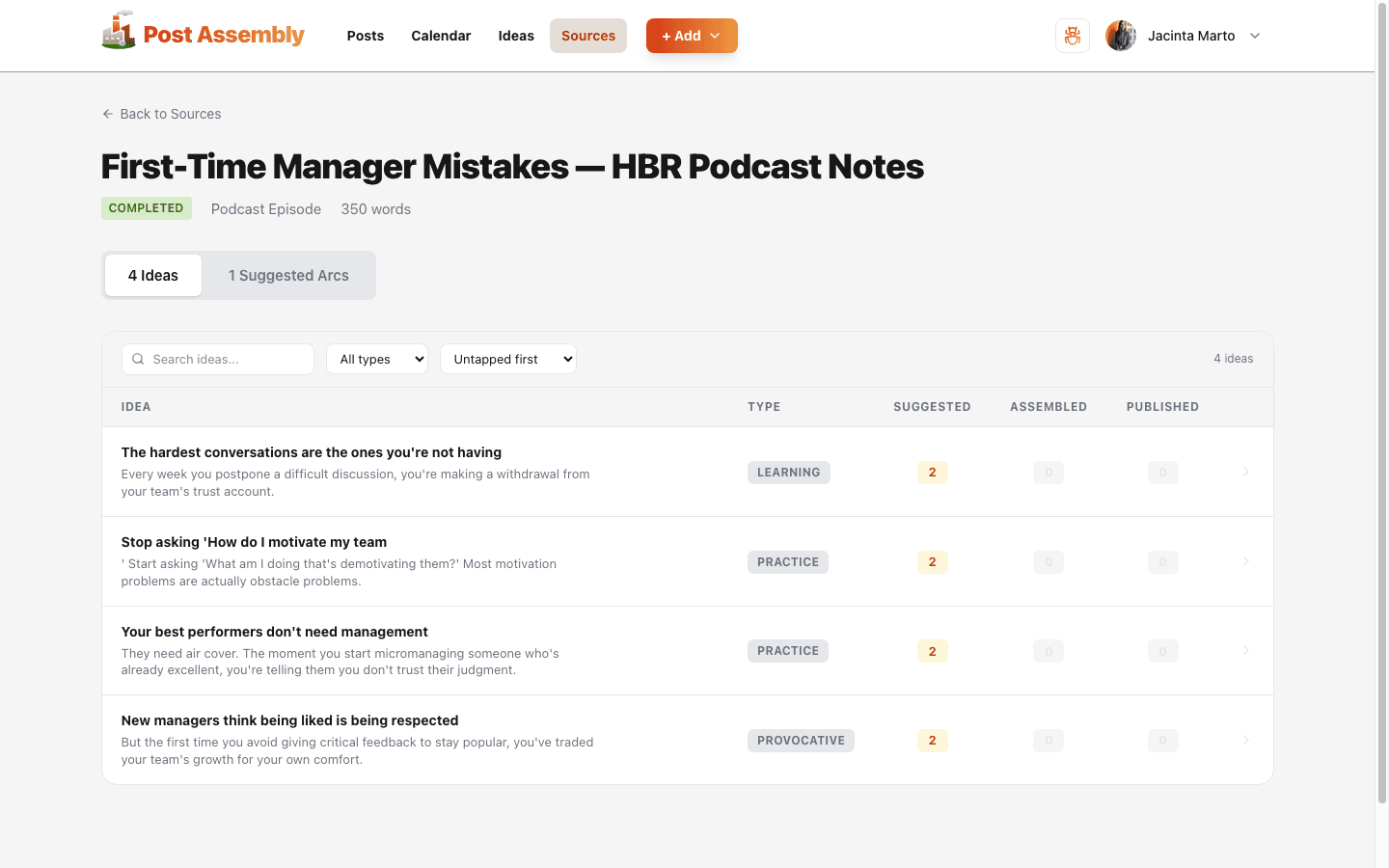
4 ideas from ‘First-Time Manager Mistakes — HBR Podcast Notes’: • The cost of silence • Liked vs. respected • Remove obstacles • Air cover, not management All four have suggested posts. Want to review any of them?
Step 2 — Assemble
Turn ideas into posts in your own voice
Most AI tools analyze your "tone" and generate text that approximates it. Post Assembly works differently: it drafts from your original idea using a voice profile built from your actual published posts. You see the draft, edit it, and decide when it's ready — in the app or through your AI agent. Every post you publish makes the next draft more accurate.
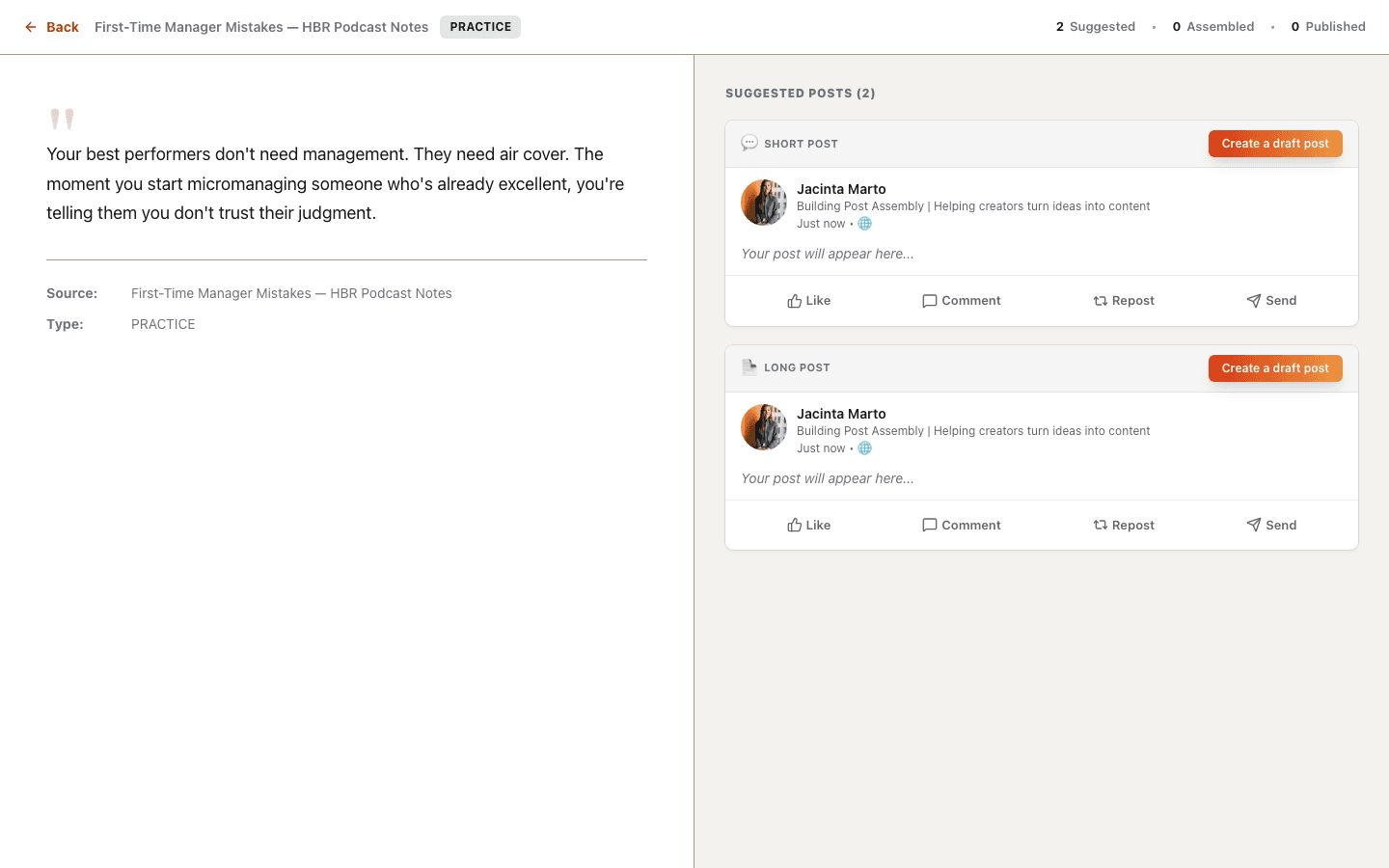
Here are 2 suggestions: a short version that stays close to your original idea, and a longer version that develops it further. Want to accept one as a draft?
Step 3 — Publish
Publish directly or schedule ahead
One-click publish to LinkedIn or schedule for later on the calendar. Your publishing history feeds back into the system — what you've already said informs what you should say next. Over time, Post Assembly becomes an editorial partner that knows your body of work as well as you do.
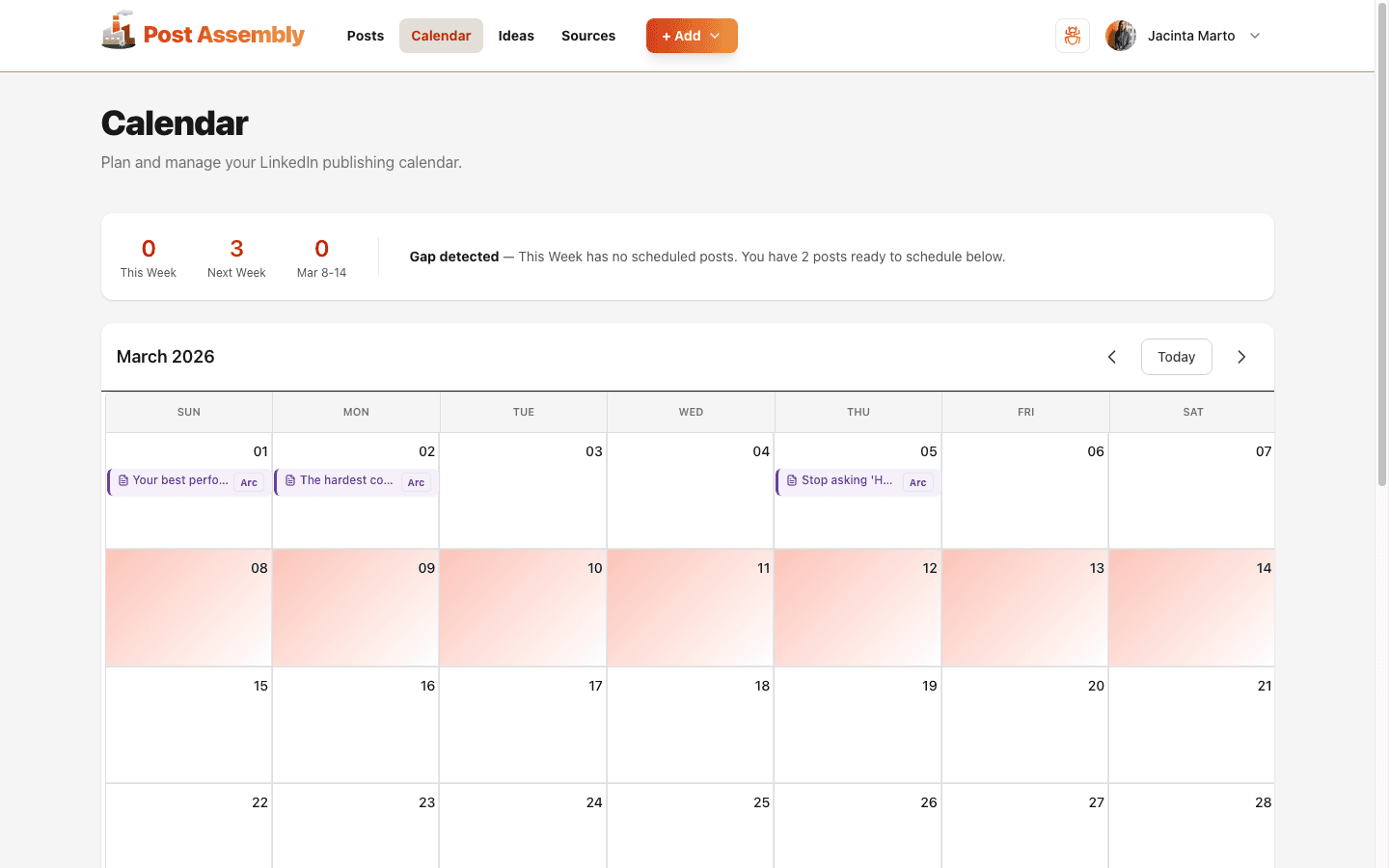
You have 4 posts scheduled this week: • Mon: ‘The platform’s role in...’ • Wed: ‘The thinking behind...’ • Thu: ‘Strategy is everything...’ • Fri: ‘More conversations...’ Tuesday is open — want to schedule a draft?
How it actually works
Every post traces back to a source
Post Assembly maintains a clear lineage from source material to published post. You can always trace a post back to the original idea, and from there to the exact moment in a transcript or document where the thinking originated.
But lineage isn't just bookkeeping. Every source you upload, every idea you develop, every post you publish feeds into a growing picture of your intellectual output. The system learns what topics you've covered, which ideas you haven't developed yet, and where the gaps are in your publishing calendar. The longer you use it, the better it gets at helping you decide what to write next.
📂 Source material
First-Time Manager Mistakes — HBR Podcast Notes
350 words · 4 ideas extracted
Why Your Best People Are Leaving
300 words · 3 ideas extracted
The Effective Executive in the Age of AI
400 words · 3 ideas extracted
Ideas extracted
The cost of silence — from First-Time Manager Mistakes
Liked vs. respected — from First-Time Manager Mistakes
Published post

Jacinta Marto
Building Post Assembly · Helping creat...
Every week you postpone a difficult discussion, you're making a withdrawal from your team's trust account.
Source attribution
Assembled from "First-Time Manager Mistakes — HBR Podcast Notes"
You have more to say than you're saying.
Upload a podcast, paste a link, drop a document — or just start a conversation with your AI agent. See what Post Assembly finds inside.